Bring Your Own Everything: The Container Crew That's Making Big Grocery Sweat
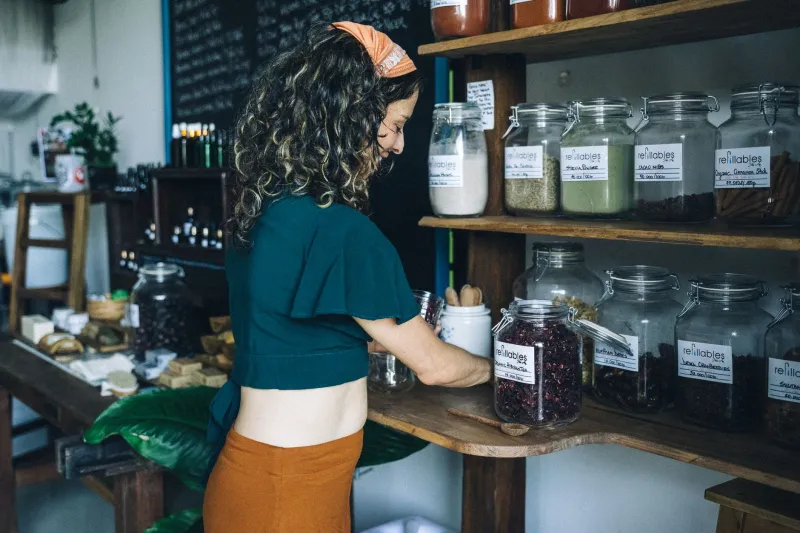
Somewhere in a Sprouts in Tempe, Arizona, a woman named Deborah is standing in the bulk aisle with a tote bag full of glass jars, a Sharpie, and the energy of someone who has absolutely nothing left to lose. She is not lost. She is not confused. She is executing a plan that has saved her roughly $340 over the last four months, and she will tell you about every single cent of it.
Deborah is part of something bigger than herself. Across the United States, a loose and largely leaderless movement of shoppers is walking into grocery stores armed with refillable containers, refusing to pay for packaging they didn't ask for and don't want. They're scooping their own oats, their own trail mix, their own coffee beans, their own dish soap in some cases — and they're daring store managers to say something about it.
Some managers do say something. Those conversations have become legendary on Reddit.
The Bulk Aisle Was Always There. People Just Started Actually Using It.
Here's the thing nobody tells you in the food media industrial complex: bulk sections have existed in American grocery stores for decades. Co-ops figured this out in the 1970s. Natural grocery chains ran with it in the '90s. But for most of that time, the bulk aisle was treated like a weird uncle at Thanksgiving — acknowledged, tolerated, mostly ignored.
Then something shifted. Inflation hit like a freight train. Shrinkflation made a mockery of every package on every shelf. A bag of almonds that used to cost $6.99 became a smaller bag of almonds that cost $8.49, and people started doing math they'd never bothered to do before. The bulk aisle math hit different. Same almonds, no bag, sometimes thirty to forty percent cheaper per ounce. Suddenly that weird uncle started looking pretty smart.
Add to that the rising cost of basically everything, and you've got an entire demographic of shoppers who are done being passive participants in a packaging racket they never agreed to.
The Jar People Are Not Playing Around
The community calls itself different things depending on where you find them — zero-wasters, bulk buyers, refill warriors, or just people who are tired of paying for plastic they immediately throw away. But the behavior is consistent: they show up with containers, they tare the weight at the register or with a scale in the aisle, they fill up, and they leave without a single piece of unnecessary packaging.
The savings are real and they're not subtle. Families reporting $50 to $100 monthly reductions in grocery bills are not outliers in these communities — they're the norm. When you stop paying for the cardboard box, the plastic liner, the resealable zipper, the branded label, and the marketing budget that convinced you this particular granola deserved a photoshoot, you're suddenly just paying for food. Novel concept.
But the money is only part of the story. Because these people are also, whether they fully intend to or not, dismantling one of retail's most profitable quiet schemes.
Corporate Grocery's Dirty Little Packaging Secret
Here's something the big chains would prefer you not think too hard about: packaging is profit. Not just because brands charge more for packaged goods, but because packaging drives impulse purchases, brand recognition, and the kind of shelf-presence that marketing departments spend millions engineering. When you walk past a wall of branded cereal boxes, you're not just looking at breakfast. You're looking at a very expensive psychological operation designed to make you reach for something you didn't come in for.
Bulk buying opts out of all of it. There's no brand to recognize, no design to catch your eye, no limited-edition packaging to make you feel like you're missing out. There's just a bin of oats and a scoop. The transaction is almost insultingly simple.
Major chains have responded to the growth of this movement with a mixture of reluctant accommodation and bureaucratic friction. Some stores have quietly expanded their bulk sections. Others have added refill stations for cleaning products and personal care items — a small but telling concession. A handful of locations have started posting explicit policies about customer-provided containers, which is the corporate equivalent of admitting you've lost control of the situation.
Then there are the stores that have responded by making the process as annoying as possible. Requiring manager approval for customer containers. Demanding containers be weighed at customer service before shopping. Implementing policies that seem specifically designed to make the whole thing not worth the effort. Spoiler: it hasn't worked. The jar people are patient. They have time. They brought snacks.
The Frugality-as-Protest Pipeline
What makes this movement genuinely interesting — and genuinely threatening to a certain kind of retail thinking — is that it operates at the intersection of saving money and making a point. These aren't people who are bulk-buying because they've been told it's trendy or virtuous. They're doing it because they ran the numbers and the numbers were insulting.
The protest energy is real but it's not performative. Nobody's making signs. Nobody's organizing a march outside a Whole Foods. The rebellion is quieter and, frankly, more effective than that. It happens every single week, in thousands of stores, one jar at a time. Every container that gets filled in a bulk aisle is a transaction that happened entirely outside the brand ecosystem. No logo got reinforced. No impulse purchase got triggered. No packaging budget got recouped.
For a retail industry that has spent fifty years perfecting the science of getting you to buy more than you planned, the container crew is a genuinely unsettling development.
What Happens Next
The trajectory here is not hard to read. Refill culture is expanding beyond bulk dry goods into cleaning products, personal care, and pantry staples. Dedicated refill stores — places that exist specifically to let you fill up containers and leave — are opening in cities across the country and slowly making inroads into mid-sized markets. The infrastructure is being built whether big retail participates or not.
The chains that figure out how to make this easy and frictionless will capture a loyalty that's hard to buy back once it's lost. The ones that keep treating jar-toting customers like a compliance problem will watch those customers drive twenty minutes to the co-op and never come back.
Deborah in Tempe already made her choice. She's got a set of labeled jars, a running spreadsheet, and the kind of quiet satisfaction that only comes from genuinely not giving a single cent to a system that was never designed with her interests in mind.
Big Flavor. Zero packaging. Zero apologies.