Sorry, Chef: Why Your $55 Wagyu Smash Is Losing to a Family-Owned Burger Shack in a Strip Mall
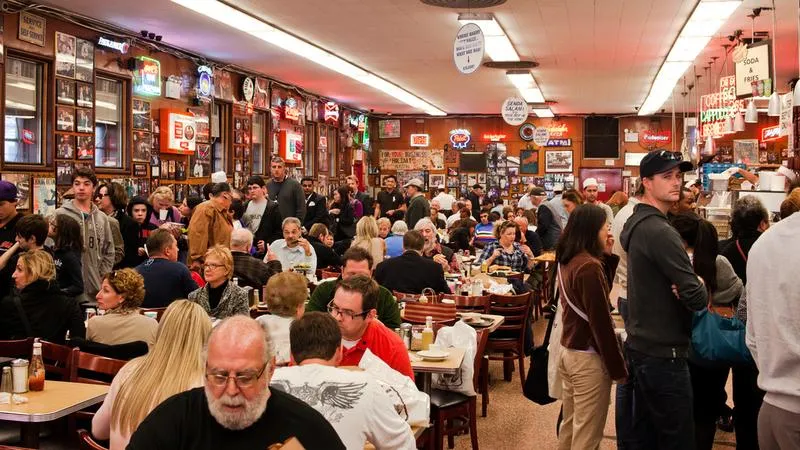
Photo: busy local burger restaurant small town America crowded counter service, via media.wnyc.org
The closure announcement always follows the same format. A somber Instagram post. A tasteful black-and-white photo of the empty dining room. A lengthy caption about "incredible journeys" and "grateful hearts" and the particular challenges of "today's restaurant landscape." The comments fill up with the food media equivalent of a candlelight vigil — dozens of journalists and culinary insiders expressing shock that a restaurant charging $38 for a small plate of artfully arranged mushrooms has, somehow, failed to achieve long-term financial viability.
Meanwhile, forty minutes away, Ricky's Burger Barn just posted a three-hour wait time on a Wednesday afternoon and their parking lot looks like a county fair.
This is the current state of American food, and it is deeply satisfying to watch unfold.
The Celebrity Restaurant Industrial Complex Is Cracking
The past two years have been genuinely brutal for the high-end, name-driven restaurant concept. Across major US markets — New York, Los Angeles, Chicago, Miami, Las Vegas — celebrity chef ventures and high-concept dining rooms have been closing at a pace that would have seemed impossible a decade ago, when the Food Network industrial complex was minting culinary celebrities faster than anyone could track.
The reasons are layered, but the economic ones are easiest to quantify. Labor costs have climbed significantly in most urban markets. Food costs are up across the board and have stayed up. Commercial real estate in the neighborhoods where these restaurants typically operate is expensive in ways that would make a reasonable person's eyes water. And the customer who was willing to spend $200 per head on a tasting menu experience — just to say they'd been there, to get the Instagram, to feel like they were accessing something exclusive — that customer is increasingly asking whether the math makes sense.
It often doesn't. And they're figuring that out.
The Strip Mall Renaissance Is Real and It's Spectacular
Here's the counter-narrative that the food press has been slow to fully reckon with: regional and local quick-service concepts are not just surviving right now, they are genuinely thriving.
The numbers back this up. While independent fine dining has struggled, independent fast-casual and counter-service operations — particularly in the burger, taco, and sandwich categories — have seen meaningful growth in both customer counts and new location openings. The operators driving this growth tend to share a few characteristics: they've been around long enough to have built genuine community loyalty, their menus are focused rather than sprawling, and their price points are defensible in a way that $55 burgers simply are not.
Take the regional burger joints that have been slowly building cult followings for years — the kind of places that don't have publicists, don't do press dinners, and whose Yelp pages are full of reviews from people with usernames like "DaveFromAkron" who have been eating there since 1997. These operations are currently printing money.
One owner of a three-location burger operation in the Southeast — who asked us not to use the restaurant's name because, and this is a direct quote, "I don't want the wrong kind of attention" — told us that 2024 has been his best revenue year since opening. "We didn't change anything," he said. "Same burger, same price formula, same staff. People just started showing up more. I think they got tired of being disappointed somewhere expensive."
That last line deserves to be stitched on a pillow.
Consistency Is the Unsexy Superpower
The thing that celebrity restaurant concepts almost categorically fail to deliver — and that beloved local spots almost categorically do — is consistency. And consistency, it turns out, is what people actually want from food when they're spending real money in a difficult economy.
When you drive forty-five minutes to a taco truck that your coworker told you about, you want the taco to taste like it did when your coworker had it. When you go to the diner your family has been going to since you were eight, you want the pancakes to taste like they always have. When the thing you're paying for is an experience built around a chef's "vision" or a rotating seasonal concept, you are, by definition, signing up for inconsistency. Sometimes that's exciting. Right now, in this specific economic moment, a lot of people are not in the mood for exciting. They're in the mood for reliable.
The regional chains and local institutions that are winning understand this at a cellular level. They have standardized their recipes not because they lack creativity but because they respect what their customers are actually buying. They're not selling novelty. They're selling the guarantee that it'll be good.
What Happens to the Chefs
It would be easy to frame this as a comeuppance narrative — celebrity chefs getting humbled by the market, learning that fame doesn't equal a viable restaurant concept. And look, there's some satisfaction in that, we're not going to pretend otherwise.
But the more interesting story is what happens to genuinely talented chefs when the vanity project model collapses. Some of them are doing something unexpected: they're opening smaller, more honest operations. Counter service. Focused menus. Reasonable prices. And when they do, the results are often genuinely excellent — because the cooking talent was always there, it was just wrapped in too much concept.
A few high-profile chef names have quietly pivoted to exactly this model in the past eighteen months, and the response has been striking. Freed from the obligation to justify a $300-per-person price tag, the food gets better. Or at least, it gets better for more people.
The Loyalty Economy Wins Every Time
At the end of the day, the restaurants that are building durable businesses right now are the ones with regulars. Not followers — regulars. People who come in on Tuesday nights because it's Tuesday and this is what they do. People who know the staff by name and whose orders are started when they walk in the door. People who would genuinely feel a sense of loss if the place closed, in a way that is qualitatively different from being mildly bummed about a restaurant you visited once for a special occasion.
That loyalty is not built with a James Beard nomination or a profile in a national food magazine. It's built with a consistent product, fair pricing, and enough years of showing up that the place becomes part of the fabric of someone's regular life.
The celebrity restaurant industrial complex never understood this. The burger shack in the strip mall never needed to be told.
Ricky's has a three-hour wait. The chef's Instagram post says "grateful for the journey." The math has never been clearer.