A Toothpick Is the Honest Unit of Measurement: Notes From the Sample Circuit
Photo: Jaggery , CC BY-SA 2.0, via Wikimedia Commons
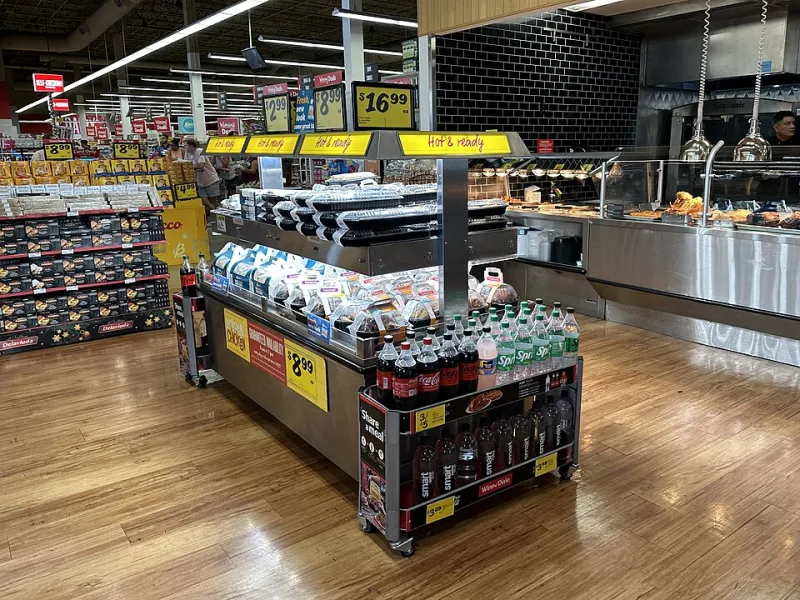
Somewhere between the pallet of forty-eight granola bars and the wall of televisions the size of a garage door, there is a woman in a hairnet holding out a small paper square with a toothpick on it. The toothpick has a cube of sausage on it. The sausage has been in a warming tray for some time, and it is not trying to be anything other than what it is.
This is, arguably, the most honest bite of food left in America.
No Personality Included
Think about the last food content you scrolled past. There was a person, probably. There was a story — a grandmother, a trip, a struggle, a small business, a hook. The food was a supporting character in a narrative designed to make you want things.
The sample table has no narrative. It has a product, a tray, a stack of napkins, and a person whose job is to be polite. There is no algorithm. There is no slow-motion pour. There is no 'I wasn't going to post this but.' There is a sausage and there is you, and the transaction takes roughly nine seconds and costs nothing, and neither party needs to become a brand afterward.
That is not a small thing in 2026. That is a structural anomaly.
How the Circuit Actually Works
The sample stations run on a loose weekly schedule, and the veterans of the club floor know it the way anglers know tides. Midweek mornings are the procession: no lines, unhurried staffers, full trays, an almost monastic calm. Weekend late morning is the crush: strollers, teens roaming in packs, a woman double-parked with a flatbed cart discussing a blender.
The reps themselves are the soul of the operation. Tracey, who has been running the same corner station for the better part of a decade, describes the work as 'part sales, part traffic control, part social work.' She has opinions about foot traffic on holidays. She has opinions about people who take one and then stand there and eat it while the line stacks up behind them. She has a system, and the system is patience.
Her professional advice for the casual sampler is surprisingly simple: take the sample, say thank you, get out of the way, and if you love it, buy it. 'The ones who come back and tell me they bought it,' she says, 'that's the whole shift right there.'
The Etiquette Ledger, Ranked
The sample aisle is the purest behavioral laboratory in retail. Here is the field guide, ordered from least to most offensive.
1. The polite decline. Civilized. Encouraged. Not a crime.
2. The single-serve loyalty. You take one, you eat it, you keep walking. Model behavior.
3. The return leg. You loop back once. Acceptable, mildly respected.
4. The kid proxy. Sending a nine-year-old to ask for an extra, knowing full well the rep cannot say no to a child. On the edge. Widely practiced. Deeply understood.
5. The tray hover. Standing adjacent to the station pretending to read a label on a box of crackers that you have no intention of buying, waiting for the next tray. This is theater, and the rep has already clocked you.
6. The interrogation. Asking detailed questions about allergens, sourcing, and whether the product is available in a smaller size, taking seven minutes of the rep's time, and then not taking a sample.
7. The cart blockade. Parking the flatbed perpendicular to the aisle so that no human being may pass. The most common offense. Zero self-awareness.
8. The double-fist. Two samples in one hand and a third in reserve. Only acceptable if you are legitimately acquiring food for a child who is elsewhere in the building. Verification impossible, so the practice continues.
9. The bulk conversion. Treating the free station as the meal itself and constructing a full lunch from four separate aisles. Some call this unethical. Some call it the finest meal in America. I will not be resolving that debate here.
Why the Toothpick Tells the Truth
A sample cube does not have a wellness angle. It does not have a story about how it was inspired by a trip to Oaxaca. It does not have a person in a linen apron explaining its origin while a camera circles overhead. It is a rectangle of food, and its only claim is: this is what it tastes like.
You will notice this the moment you bite in. There is no expectation management. It is either good or it is not, and you know the answer before the toothpick hits the napkin. That kind of immediate, unmediated judgment is a rarity now. Everything else you eat has been marketed to you, sometimes by an algorithm that knew what you were thinking about two days before you did.
The sample table is the last holdout of a simpler transaction: here is a bite, decide for yourself.
Bring a napkin. Say thank you. Move along.